 “What literature can and should do is change the people who teach the people who don’t read the books.”
―
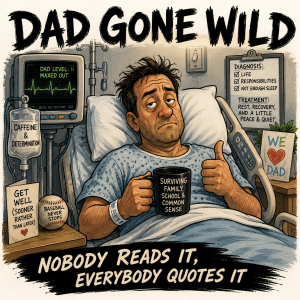
Two weeks ago today I was sitting in the bleachers watching my son’s baseball game.
The game had ended, parents were beginning to drift toward the parking lot, and we were making our way down the bleachers to meet up with the boys. It was one of those completely ordinary moments that make up most of life. Nothing memorable. Nothing remarkable.
Then, for just a second, I got distracted.
I missed the last step.
Gravity did what gravity has done since the beginning of time, and 235 pounds of middle-aged dad slammed squarely into the steel railing behind the backstop.
There isn’t an elegant way to describe what came next.
The wind left my body instantly. If you’ve ever had the breath knocked out of you, you know that terrifying feeling where your lungs simply refuse to cooperate. Your brain is screaming, “Breathe!” while your body is busy pretending it has never heard of oxygen.
Eventually, the air came back.
The embarrassment arrived first.
Because once you reach your fifties, falling in public isn’t just painful—it becomes a public event.
The first thing you do isn’t check to see if you’re injured.
You look around to see who witnessed your humiliation.
I dusted myself off, assured everyone I was fine, and walked to the car convinced I’d be sore for a few days.
After all, dads don’t get hurt.
We get “a little banged up.”
The next morning was painful.
Everything hurt.
Rolling over in bed hurt.
Standing up hurt.
Laughing hurt.
Breathing hurt.
Still, I had a wedding to bartend.
Anyone who’s worked weddings knows there really isn’t much room for calling in sick. Brides generally aren’t interested in hearing that the bartender’s ribs are a little cranky.
So I loaded the van, showed up, smiled for eight hours, mixed drinks, shook cocktails, carried ice, and somehow convinced myself everything would work itself out.
That’s one of the great lies middle-aged men tell themselves.
“It’ll be fine.”
Usually accompanied by another classic:
“I don’t need to see a doctor.”
By Monday evening, even I had to admit this wasn’t getting better.
Every breath seemed a little shorter.
Every movement hurt a little more.
Sleeping had become an exercise in creative positioning.
Just down the road from my house sits one of those brand-new neighborhood emergency rooms.
My plan was simple.
Slip in.
Get an X-ray.
Have somebody tell me I bruised a rib.
Pick up a prescription.
Go home.
Be in bed by ten o’clock.
You know what they say about the best laid plans.
Within an hour I wasn’t headed home.
I was headed to TriStar Skyline Trauma Center.
The scans revealed two broken ribs and a rather significant hemothorax. Blood had begun collecting around my lung.
Apparently, falling down bleachers is a little more complicated at fifty-something than it was at fifteen.
The trauma team moved quickly.
Doctors calmly explained they needed to make an incision in my side and insert a chest tube to drain the blood.
Five minutes earlier I thought I needed an X-ray.
Now I had plumbing.
It’s amazing how quickly life adjusts your expectations.
Just like that, my quick trip to the emergency room became a five-day stay in the trauma unit.
I’ve spent the better part of the last decade writing about education.
Politics.
School boards.
Government.
Media.
People telling carefully crafted stories that don’t always match reality.
If you’re not careful, you can become cynical.
Maybe even a little jaded.
Spend enough time reading social media and cable news and you begin believing America is nothing more than people yelling at each other.
Everybody’s angry.
Everybody’s offended.
Everybody’s convinced the other side is destroying the country.
Then life has a funny way of forcing you outside your own little bubble.
Lying in a trauma unit for five days gave me a front-row seat to a different America.
One you rarely hear about.
Trauma nurses.
Respiratory therapists.
Patient care technicians.
Housekeeping staff.
Doctors.
People whose names you’ll never know but whose work matters every single day.
There isn’t a glamorous thing about what they do.
Television has completely lied to us.
Hospital dramas somehow manage to make nursing look exciting.
Reality looks a little different.
Reality is twelve-hour shifts.
Reality is cleaning blood.
Reality is cleaning vomit.
Reality is cleaning things I won’t mention because some of you are probably eating breakfast.
Reality is helping complete strangers through the worst day of their lives.
Over and over again.
For twelve straight hours.
I watched these nurses move from room to room without ever really stopping.
There were no extended coffee breaks.
No gathering around the water cooler to debate Taylor Swift’s latest appearance at Tight End University.
No disappearing into the office for an hour.
Just constant motion.
Blankets.
Medication.
Bandages.
Questions.
Families.
Monitors.
Call lights.
One patient after another.
Hour after hour.
And somehow…
They smiled.
Not fake smiles.
Real ones.
The kind that make frightened people feel like everything might actually be okay.
I found myself watching them more than I watched television.
There was something remarkable about the quiet professionalism.
Nobody was looking for applause.
Nobody was updating social media.
Nobody was issuing a press release celebrating another record-setting day.
They simply did the work.
At one point I finally asked my nurse a question that had been bouncing around in my head for days.
“Why in God’s name would you want this job?”
She laughed.
Then she explained.
She talked about helping people.
Being present for families.
Making a difference on someone’s worst day.
Despite her best efforts…
I’m still not sure I completely understand.
Because if you gave me a choice between cleaning trauma rooms or breaking up an argument between fraternity brothers over who drank the last bottle of Tito’s…
I’m probably choosing the fraternity.
But Lord am I grateful people like her exist.
They reminded me of something I’ve slowly forgotten.
The America portrayed every night on television isn’t the only America.
There is another one.
One where people quietly go to work every day.
One where strangers sacrifice for strangers.
One where service still matters.
One where humanity takes precedence over ideology.
That entire week…
Not one person asked me if I voted for Donald Trump.
Not one person asked whether I supported Joe Biden.
Nobody asked about immigration.
Nobody asked where I stood on vouchers.
Nobody wanted my opinion on the latest Supreme Court ruling.
Nobody cared.
They wanted to know one thing.
Was I breathing?
Funny how quickly politics disappears when someone is trying to keep your lung inflated.
There’s probably a lesson in that.
One we could all stand to remember.
Today I’m home.
Still sore.
Recovery is going to take a while.
Broken ribs are patient teachers.
Every cough gets your attention.
Every sneeze becomes a religious experience.
Sleeping remains something of a competitive sport.
But I also came home with something I wasn’t expecting.
A renewed appreciation for the people who quietly keep this country running.
To every trauma nurse…
Every respiratory therapist…
Every patient care technician…
Every doctor…
Thank you.
You have my complete respect.
Though if you don’t mind…
I’m going to go back to admiring you from afar.
I’d really prefer not to see any of you again.
That hospital stay also gave me plenty of time to think.
Unfortunately…
That means all of you now have to read it.
I’ve always said that he who controls the cut scores controls the narrative.
It’s a principle that continues to prove itself year after year.
Imagine I walked into your workplace tomorrow and announced we’d developed a brand-new evaluation system.
Every employee would be judged by it.
Raises would depend on it.
Promotions would depend on it.
Bonuses would depend on it.
Job assignments would depend on it.
There would be only one catch.
You’d never actually get to see the assessment.
We’d administer it behind closed doors.
Disappear for a month.
Then come back and tell you how you did.
“Congratulations. You exceeded expectations.”
Or maybe…
“You need improvement.”
Either way, you’d never know why.
You couldn’t review the questions.
You couldn’t challenge the grading.
You couldn’t compare your answers with anyone else’s.
You’d simply have to trust us.
Most of you would laugh us right out of the building.
Yet that’s essentially how we continue to evaluate schools and students.
Every summer we’re handed another collection of charts and graphs.
Press releases proclaim “historic gains.”
Districts celebrate “record-breaking achievement.”
Politicians congratulate one another on “bold leadership.”
Meanwhile, the actual assessment remains largely hidden from the people whose lives are shaped by it.
The public is expected to applaud from a distance.
Just trust us.
This week, state and district leaders received the latest TCAP results before the public did, giving everyone time to prepare their talking points before parents ever saw a headline.
And, as if on cue…
Everything was wonderful
According to the Tennessee Department of Education, third-grade English Language Arts proficiency reached its highest level since at least 2017. Third-grade ELA proficiency increased by 3.2 percentage points from last year. Eighth-grade ELA climbed 2.7 points. English II rose 3.8 points. Fourth-grade math increased 3.6 points, and high school Geometry jumped an impressive 5.6 points.
Education Commissioner Lizzette Reynolds celebrated the results.
“I am very proud of our gains in student achievement, highlighting our success in implementing strategies that elevate learning across all grades and subjects. This continued progress ensures every Tennessee student has the opportunity to succeed.”
That’s the part that always catches my attention.
Our success.
Our strategies.
Our implementation.
Education bureaucracies are remarkably eager to take credit for improved scores.
But here’s my question.
How exactly do we know which strategy produced which result?
Schools are enormously complicated organizations.
Student learning is influenced by parents, teachers, attendance, poverty, curriculum, tutoring, technology, discipline, motivation, nutrition, sleep, class size, school leadership, and about a thousand other variables.
How do you isolate one variable and confidently proclaim:
“This is why scores improved.”
The honest answer is…
You really can’t.
Yet every summer we hear the same carefully crafted story.
The strategy worked.
Leadership worked.
The plan worked.
Mission accomplished.
Read the quotes attached to these results and one thing becomes abundantly clear.
Everybody already knows who’s getting the credit.
Chelsea Crawford, Executive Director of TennesseeCAN, put it this way:
“Once again, Tennessee is proving that meaningful progress is possible when leaders stay relentlessly focused on measurable student learning. Our students can and will achieve at high levels when we set high expectations, measure learning honestly, and refuse to lower the bar.”
Well…
Thank goodness we have those leaders.
Over at Metro Nashville Public Schools, it was more of the same.
According to the district, this year’s results prove that the momentum is “real, sustained, and undeniable.”
The district highlighted gains in English Language Arts, mathematics, and social studies.
Social Studies jumped 4.1 percentage points.
English II increased 6.5 points.
Integrated Math III climbed an eye-popping 7.9 points.
The district also noted that MNPS outpaced the state in several tested subjects.
Then came the quote everyone expected.
“Our success is undeniable, and it belongs to our students and the educators who believe in them. By staying focused on improving the conditions for teaching and learning, we are giving our students the support they need to thrive. Building on last year’s record results, these gains reflect the determination of our students and their families, the dedication of our teachers, and a community committed to excellence. We could not be prouder, and we are just getting started.” — Dr. Adrienne Battle
Maybe she’s right.
I sincerely hope she is.
Every child in Nashville deserves an outstanding education.
But here’s where I continue to struggle.
How do we know?
Not how do we know the scores increased.
We know they did.
How do we know the scores tell the entire story they’re being asked to tell?
Those are two completely different questions.
Maybe these gains represent genuine improvements in student learning.
Maybe they don’t.
Maybe they’re somewhere in between.
The point isn’t that the numbers are wrong.
The point is that the public has almost no ability to independently verify the narrative built around them.
We’re simply told to believe.
Trust us.
It reminded me of my week in the trauma unit.
Nobody asked me to trust blindly.
When they inserted a chest tube, they explained exactly why.
When they ordered another CT scan, they showed me the images.
When my lung improved, they showed me the X-rays.
Transparency builds confidence.
Education too often asks for confidence without transparency.
That may explain why Metro Council recently approved the district’s $1.437 billion budget while simultaneously insisting on something many people inside the district apparently found offensive.
An independent performance audit.
Think about that for a second.
The largest single investment Metro makes each year.
Nearly a billion and a half dollars.
The last operational and performance audit was conducted in 2014.
Twelve years ago.
Since then, district enrollment has declined while the budget has nearly doubled.
If you’re a taxpayer, asking a few questions seems perfectly reasonable.
Metro Council Budget Committee Vice Chair Jason Spain certainly thought so.
“This is the largest single investment that Metro makes, and I think it’s incumbent upon us to make sure that we are seeing a return on that investment,” Spain said. “What we hear from the school board is all about growth: TVAAS level five growth for four years running, and historic highs, and graduation rates, and ACT scores, which is all great and worth celebrating. It absolutely is, but it doesn’t tell the whole story. I want to see not just comparisons to where we’ve been, but comparisons to where we should be.”
There it is.
That’s the conversation we should be having.
Notice what Spain didn’t say.
He didn’t dismiss the district’s accomplishments.
He didn’t accuse anyone of manipulating scores.
He didn’t suggest teachers weren’t working hard.
In fact, he explicitly said those accomplishments were “worth celebrating.”
His point was something entirely different.
Growth matters.
Progress matters.
But growth alone doesn’t answer the bigger question.
Are we where we should be?
If I make a 40 on a test one year and a 50 the next, I’ve unquestionably improved.
I’ve also still failed.
Context matters.
That’s why performance audits matter.
They’re not designed to erase success.
They’re designed to determine whether the success we’re celebrating matches the investment taxpayers are making.
Those two ideas aren’t mutually exclusive.
In fact, they should go hand in hand.
The response from the school board surprised me.
MNPS Budget Committee Chair Berthena Nabaa-McKinney told The Nashville Banner:
“It blindsided all of us as a board. It blindsided district leadership. To this day we still don’t have a clear explanation of what the goals or objectives are.”
Then came the discussion over how to fund the district’s portion of the audit.
After lengthy debate, the board chose to eliminate funding for the Hillwood Early Learning Center.
A budget item that directly impacts children.
That certainly was a choice.
Personally…
I might have started somewhere else.
Maybe the travel budget.
Maybe conferences.
Maybe administrative spending.
Maybe some of those professional learning trips that somehow always seem to involve hotels in another city.
Call me old-fashioned, but if I’m looking for less than one-half of one percent of a $1.437 billion budget, my first instinct probably isn’t to begin with services for children.
Spain noticed the same thing.
“It’s concerning that they couldn’t find a way to find less than four hundredths of 1 percent of their budget without impacting services to students, and that’s sort of the point of the audit. I think pre-K is a good use of those funds. … I know they place a great emphasis on supporting their employees, and that’s incredibly important. They had other options available to them.”
He wasn’t finished.
“They didn’t raise an eyebrow at [the legal settlement] and apparently found a way to pay for that without impacting services to students. They spent $165,000 on a bathroom renovation, and that’s fine if they’ve got the funding available to do it, but the point is those types of expenses didn’t give them pause or cause them to make cuts to programs that serve our students, so I don’t see why it was necessary that this one did.”
Council Budget Chair Kyonzté Toombs largely agreed.
She questioned whether the district had dug deeply enough to identify the approximately $470,000 it needed without reducing services to students.
Personally, I look forward to seeing the audit.
Not because I’m convinced it’s going to uncover some earth-shattering scandal.
Maybe it will.
Maybe it won’t.
But transparency has a funny way of building confidence.
If everything is working as well as we’re told, then an independent audit should reinforce that story.
If improvements are needed, taxpayers deserve to know that too.
Either outcome is a win.
Because accountability isn’t the enemy of public education.
It’s one of the things that makes public education worthy of the public’s trust.
Quick Hits
Williamson County
Longtime Williamson County Schools Superintendent Jason Golden has announced his resignation just days after receiving a new contract. He’ll become Associate Director of Finance, Administration, and Legal Services for the Franklin Special District. Williamson County now begins another superintendent search. If I were advising MNPS, I’d encourage Deputy Superintendent Mason Bellamy to throw his hat into the ring. It gets him his first superintendent’s job, gives Williamson County an experienced administrator, and provides a little organizational clarity back in Nashville. Everybody wins. Well…maybe not everybody.
MNPS
Chief Strategy Officer Sarah Chin is expected to leave the district at the end of July. Whether the rumors about her influence are true or not, losing your chief strategist is never insignificant. It’ll be worth watching who Dr. Battle chooses to fill one of the most important positions in the district.
Five days in a trauma unit reminded me of something I’d forgotten.
There are still people who quietly go to work every day without demanding applause.
They don’t issue press releases.
They don’t hold victory laps.
They don’t proclaim “historic achievements.”
They simply do hard things for complete strangers.
They earn trust one patient at a time.
Education could learn something from that.
Trust isn’t built with slogans.
It isn’t built with glossy reports.
It isn’t built by declaring your own success.
It’s built through transparency.
It’s built through accountability.
It’s built by inviting people to look under the hood instead of asking them to admire the paint job.
Broken ribs heal.
Mine will.
Eventually.
Broken trust?
That takes a whole lot longer.
If You Enjoy Dad Gone Wild
If you enjoy independent education reporting with a healthy dose of sarcasm, please consider supporting Dad Gone Wild.
The easiest way to help is by subscribing to the newsletter and sharing it with someone who enjoys thoughtful discussion about education, public policy, and the occasional misadventure of an aging dad.
If you’d like to support the work financially:
Venmo: @Thomas-Weber-10
PayPal: Norinrad10@yahoo.com
Every subscription, share, and contribution helps cover the time it takes to research public records, attend meetings, and continue telling stories that too often go untold.
Thank you for reading.
And remember…
Categories: Education


Leave a comment